Clovis, 6 Nov 2026
AI ROI for Thai Companies: Pick One KPI Before You Automate
NECTEC's 2026 survey found 53.7% of Thai organizations use AI, but 86.4% of those users cannot say what it delivered. The fix is smaller than a platform: one workflow, one KPI, a two-week baseline.
AI ROI for Thai companies comes down to one comparison: the same number, measured the same way, before and after you automate. Pick one workflow, pick one KPI, and count it for two weeks before you buy anything.
That sounds obvious. The data says it is not. NECTEC's AI Readiness 2026 survey of 574 Thai organizations found that 53.7% now use AI, but 86.4% of those users cannot say what it delivered (NECTEC, 3 September 2026). Most are not failing at AI. They are failing at measurement.
We build these workflows at N2o, and the pattern is consistent: the tool gets bought first, the target gets defined later, and sometimes never. Here is the order that works, without a consulting project.
Key Takeaways
- NECTEC's 2026 survey of 574 Thai organizations found 53.7% use AI, but only 13.6% measured a clear positive result (NECTEC, 3 September 2026).
- The rest cannot state an outcome yet: almost half never measured, and the others are still collecting data.
- Choose one workflow, one KPI and one guardrail, then baseline the KPI for two weeks before any tool is bought.
- After go-live, compare the same KPI the same way for two to four weeks. No movement means no return, whatever the demo showed.
What NECTEC's 2026 survey actually found
NECTEC, part of NSTDA, surveyed 574 public and private organizations across 10 target industries between June and July 2026. It is the closest thing Thailand has to a national baseline on AI use, so it is worth reading past the headline. AI use more than tripled in two years, from 17.8% in 2024 to 53.7% in 2026. Average readiness, though, fell from 55.1% to 40.0%, which NECTEC still grades "Aware". The weakest pillars are technology at 32.2% and governance at 28.9% (NECTEC, 3 September 2026). Companies bought access faster than they built the data, process and controls to use it.
Size matters less than you would expect. Large organizations lead on adoption at 67.2%, against 48.5% for medium and 43.8% for small. Every size band is still rated Aware, and large firms score 41.1% on readiness against 35.9% for small ones (NECTEC, 3 September 2026).
Manufacturing has the highest AI use of any sector, with education second. That is the part I care about, because it means the measurement gap sits exactly where operational cost concentrates. The same patterns show up in the workflows on our manufacturing automation page.
Why 86.4% of Thai AI users can't show a result
Here is the number that should stop a management meeting. Of the 308 organizations using AI, 86.4% cannot say what it delivered: 49.4% never measured, and 37.0% are still collecting data. Only 13.6% measured and found a clear positive result (NECTEC, 3 September 2026).
The charitable reading is timing. Some of that group is mid-measurement, and their honest answer is "not yet" rather than "no". The less charitable reading is that nobody agreed what "working" meant before the tool arrived.
Executive attention is not the bottleneck. 89.3% of executives say they are alert to AI, but only 23.4% have committed budget (NECTEC, 3 September 2026). The share that has built AI into strategy at every level is 8.4% (NECTEC press release, 3 September 2026). Attention without a number is a subscription, not a strategy.
NECTEC's director, Dr. Chai Wutiwiwatchai, framed the task in similar terms: the goal is not more AI users, but AI that fits the work, with the data, people and measurement in place to prove it.
Thai business press led with the same two numbers that week: 53.7% adoption against 40% readiness (Thansettakij, 7 September 2026).
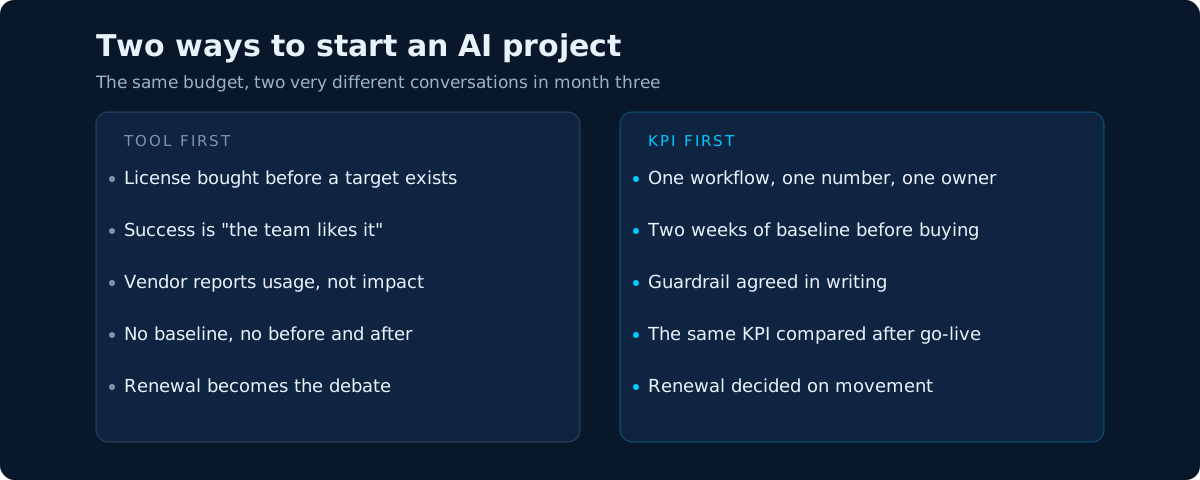 A baseline turns an AI purchase into a measurable decision. It also gives you a reason to stop.
What the 13.6% measured, and what they couldn't
The 42 organizations that measured reported improvements in a predictable order. Every one of them saw less time and fewer steps; 95% reported fewer errors and 83% more output per person. Lower operating cost followed at 71%. Revenue and market share lagged at 55% (NECTEC report, September 2026).
That ordering is the most useful thing in the document. Time and errors sit close to the work, so they move first and are easy to attribute. Revenue depends on price, demand and sales execution, none of which one workflow controls.
So pick a KPI you can attribute. "More sales" is a business outcome with ten inputs. "Minutes per order" has one.
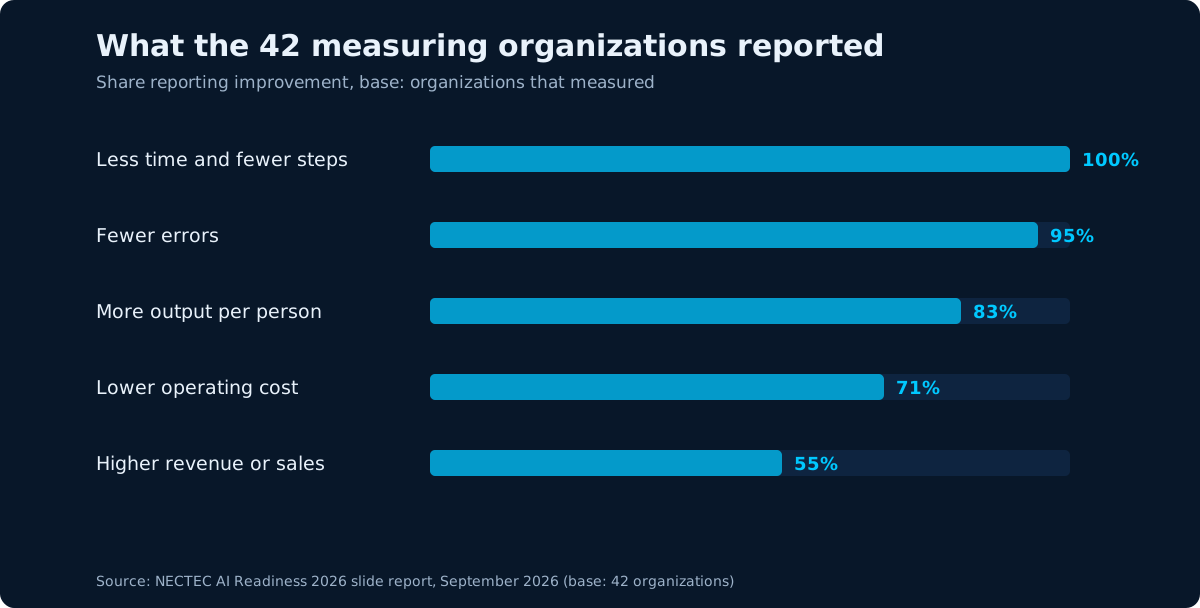 Internal efficiency moves first; revenue moved for just over half. Source: NECTEC AI Readiness 2026 slide report, slide 11 (base 42).
Note the base: 42 organizations out of 308. This is a small, self-selected group that bothered to measure. Treat the pattern as a direction, not a benchmark.
How to measure AI ROI on one workflow, in four steps
AI ROI for Thai companies does not need a platform, a steering committee or a six-month roadmap. It needs one workflow, one number and two weeks of honest counting. This is the sequence we use before quoting a build.
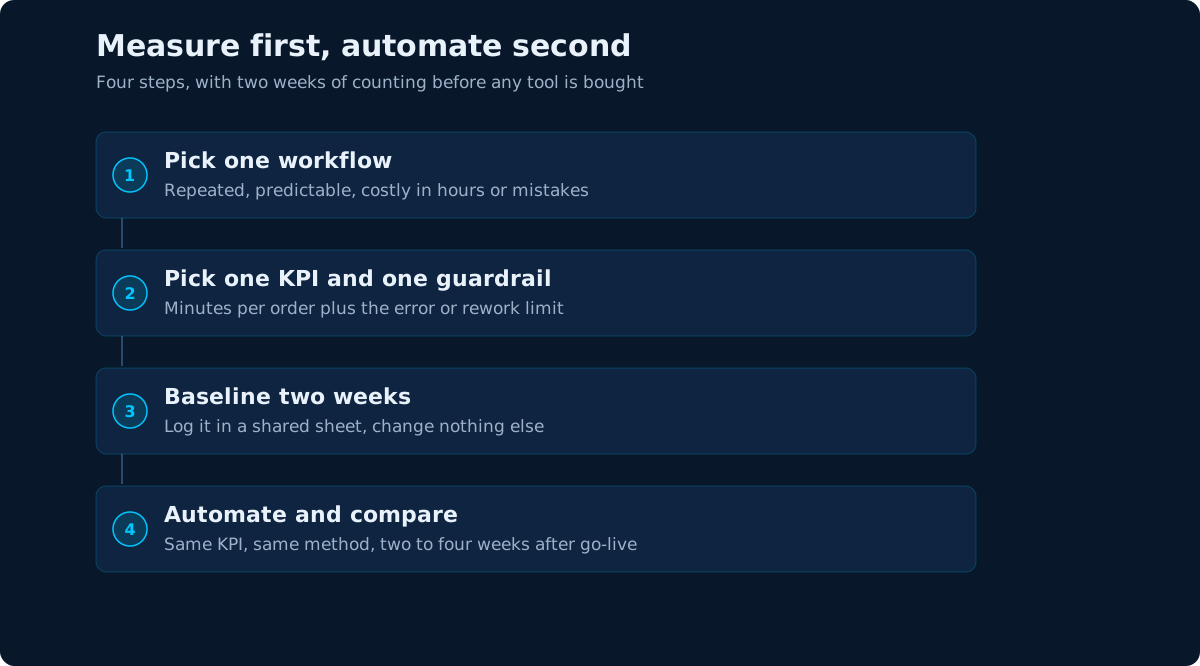 The baseline is the part most projects skip. Without it, the after number has nothing to compare against.
1. Pick one workflow, not a department
Choose work that is repeated, predictable and expensive in hours or mistakes: order entry from PDFs and LINE photos, quotation turnaround, supplier confirmations, a production handoff rebuilt from three spreadsheets. If you cannot describe the trigger and the output in one sentence, it is not a workflow yet.
2. Pick one KPI and one guardrail
The KPI is what should improve: minutes per order, quote turnaround in hours, errors per 100 orders, overtime hours per month. The guardrail is what must not get worse: error rate, rework, complaints, or the number of orders a person still has to touch. One of each. A dashboard with nine metrics is how projects avoid being judged.
3. Baseline for two weeks, and change nothing else
Log the KPI in a shared sheet, or pull timestamps from the ERP and email. Two weeks is enough to see a range and catch the Friday spike. Do not improve the process while you baseline it, or you will not know what moved the number.
4. Automate the smallest scope, then compare the same number
Go live with the narrowest change that touches the KPI. Two to four weeks later, measure the same KPI the same way. If the number moved, you have a return. If it did not, you have a demo.
What a two-week baseline looks like
Here is the arithmetic on a made-up 120-person parts maker. Not a client, not a case study: every figure below is an assumption, chosen to show the method. Replace them with your own counts.
| Measure | Baseline, two weeks | Target after go-live |
|---|---|---|
| Orders per month | 1,200 | 1,200 |
| Minutes per order, including checks | 9 | 3 |
| Admin hours per month | 180 | 60 |
| Errors per 100 orders | 4 | 1 |
| Time to draft sales order | Batched twice a day | Minutes |
The hours are the easy part: 1,200 orders at six minutes saved is 120 admin hours a month. Whether that is real money depends on what you do with them. If nobody is released from the desk, the saving stays on the slide.
The guardrail matters more than the headline. At four errors per 100 orders, 48 orders a month need rework. At one, it is 12. Saving six minutes an order is worthless if the error count climbs to eight per 100. The team has simply got faster at being wrong.
What the build has to cost to pay back
Saving hours only becomes ROI when the build cost sits underneath them. Keep the same made-up 120-person parts maker: no client, every number an assumption.
Say the quote is 240,000 baht to build the intake flow, and a loaded admin hour costs 350 baht. The 120 hours saved are worth 42,000 baht a month. Add a licence and the hours still spent on exceptions at 6,000 baht a month, and the net benefit is 36,000 baht. Payback is 240,000 ÷ 36,000, or 6.7 months.
Put those lines in the case and the arithmetic becomes a ratio a CFO can sign:
| Line | Assumption |
|---|---|
| Build and integration | 240,000 baht, one off |
| Monthly run cost | 6,000 baht, licence plus exception handling |
| Monthly benefit | 42,000 baht in released admin time |
| Net monthly benefit | 36,000 baht |
| Payback | 240,000 ÷ 36,000 = 6.7 months |
Write the threshold down before you ask for budget. If finance's cut-off is twelve months, this one clears it. If it is six, the case is marginal and the scope should shrink. A licence that costs 6,000 baht a month turns a 5.7-month payback into 6.7, which is why the run cost belongs in the same table as the benefit.
The build itself is usually less dramatic than the baseline. Automated order intake holds ambiguous lines for a person instead of guessing, which is what keeps the guardrail from moving the wrong way.
When chasing AI ROI isn't worth it
Some workflows should stay manual, and saying so is part of the job.
Skip automation when volume is a handful of orders a day, when one clean EDI feed already carries the data, when the process changes every month, or when nobody will own the KPI after go-live. In those cases a spreadsheet rule, a template or a checklist is cheaper and easier to trust.
There is also a control question. A document read can run on its own. A customer message or a payment should wait for one click in the team chat or the ERP, with a deterministic script checking the line math, the VAT and a Buddhist-era date before anything reaches the ERP. If a vendor cannot say which step acts alone and which one waits for a person, the ROI case is not ready. The split is described on our AI agents and automation page.
The honest test: if the automation disappeared tomorrow, would anyone notice in the numbers? If not, it was never measuring anything.
Conclusion
Adoption is no longer the story. The progress is real, and it took two years. The next gap is proof, and it will not close by buying more tools.
Pick one workflow this week. Write down one KPI and one guardrail. Count for two weeks. Then decide whether to automate, and compare the same number afterward.
That sequence costs two weeks and a spreadsheet. It is also the difference between saying "we use AI" and showing what it did.
I hope this was helpful. If you want to test this on one of your own workflows, book a call for a free 30-min Workflow ROI Blueprint — bring the repetitive task that costs your team the most hours every week — or email me at clovis@n2olabs.ai.
Thank you,
Clovis
Sources
- NECTEC press release, 3 September 2026 (in Thai) — AI Readiness 2026 announcement: 574 organizations, 53.7% adoption, 86.4% unable to state results, size breakdown.
- NECTEC-ACE 2026 session summary, 3 September 2026 (in Thai) — readiness index, pillar scores, sector results, 23.4% budget commitment.
- NECTEC AI Readiness Assessment 2026 slide report, September 2026 (in Thai) — slides 6 to 12, including the results breakdown for the 42 organizations that measured.
- Thansettakij, 7 September 2026 (in Thai) — independent coverage of the 53.7% adoption and 86.4% measurement gap.