Clovis, 18 Nov 2026
PDPA AI guidelines: what Thai factory chatbots should log
Thailand's PDPC published AI guidelines in November 2026. They are not law, but they set out what a factory order agent should log so a 72-hour breach report is possible.
Thailand's Personal Data Protection Committee issued its AI guidelines in October 2026 and published the notification in the Royal Gazette on 2 November 2026. They are not law. They say how the existing PDPA applies when a factory runs a chatbot, a document reader or an order-intake agent that touches customer data.
For an order desk, the useful part is narrow: prompts, interaction logs and vector embeddings can all be personal data (Tilleke & Gibbins, 14 October 2026). That turns an agent's audit trail into compliance evidence rather than a debugging convenience.
If you cannot say which customer records an agent read before it posted a sales order, you cannot scope a breach report inside 72 hours.
Key Takeaways
- The PDPC's AI guidelines (Version 1.0, Royal Gazette 2 November 2026) are guidance, not new law: they explain how the PDPA applies to prompts, logs and embeddings.
- The binding duties are older than the guidance. A record of processing under Section 39, security under Section 37(1), erasure under Section 37(3) and a breach report within 72 hours under Section 37(4) all apply to an order agent today.
- Six fields per agent run are enough to scope a breach without reading every order: actor, input, records read, output, write, and the exception that was held.
- Most order agents do not need a DPIA. They start to need one when the agent sets credit terms, scores customers or touches employee health data.
What the PDPC published, and what it does not do
The guidelines come in a notification issued under Section 16(3) of the Personal Data Protection Act, with a Version 1.0 document attached (PDPC, 2 November 2026). They cover the full AI lifecycle, from planning and data preparation through decommissioning, and apply to analytic, generative and agentic systems (Tilleke & Gibbins, 14 October 2026).
The document has no binding legal effect, does not determine liability, and is not an authoritative ruling on a legal question (Formichella & Sritawat, 12 November 2026). So a DPIA, an AI inventory or a named agent account is a recommendation here, not a new statutory duty.
What binds you is the PDPA, and it already covers the agent:
| Duty | Source | Status |
|---|---|---|
| Record of processing activities | PDPA Section 39 | Binding |
| Appropriate security measures, reviewed when technology changes | PDPA Section 37(1) | Binding |
| System for erasure or destruction when the purpose ends | PDPA Section 37(3) | Binding |
| Breach report to the PDPC within 72 hours where feasible | PDPA Section 37(4) | Binding |
| AI inventory, DPIA, agent accounts, least privilege | PDPC AI guidelines | Recommended |
If your factory keeps a record of processing and a breach procedure, the guidelines tell you how to apply them to AI. If it does not, no prompt engineering fixes that.
When prompts, logs and embeddings become personal data
The PDPA defines personal data as information that identifies a person directly or indirectly (PDPA, 2019). The guidelines apply that to the parts of an AI system most teams never classify: prompts and inputs, logs and usage records, embeddings and vector data, and outputs that identify a person (Tilleke & Gibbins, 14 October 2026).
A LINE order message is the test. It usually carries a contact name, a phone number and a delivery address, and sometimes the name of the person who signed the purchase order. Copy that into a prompt and personal data sits in a third place: not only the ERP and the chat, but the agent's prompt log.
Embeddings get less attention and cause more trouble. A customer list turned into vectors is still personal data if the vectors can be reversed or combined with other records, and a model trained on personal data is not automatically anonymized because the training data is no longer readable (Tilleke & Gibbins, 14 October 2026). If a vendor says the model "only learned patterns", ask what it would produce for one customer.
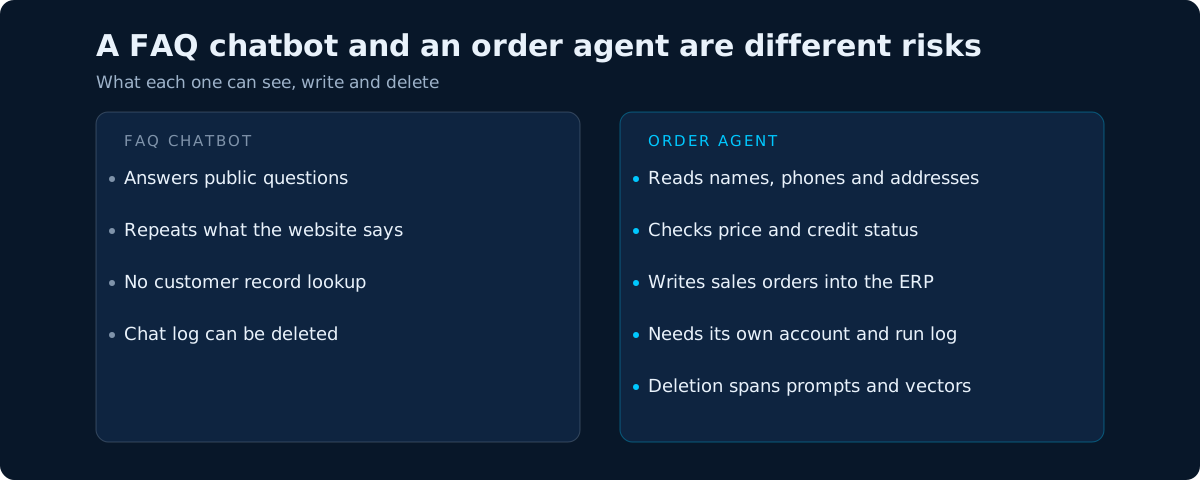 The second column is the system these guidelines matter most for.
Retention rules, access controls and deletion requests now have to reach the vector store and the prompt log, not the ERP alone.
The record that decides whether you can report in 72 hours
Section 37(4) requires a controller to notify the PDPC of a personal data breach without delay and, where feasible, within 72 hours of becoming aware of it, and to notify affected people when the risk is high (PDPA, 2019).
The clock starts at awareness, and awareness is the weak point. An agent that reads hundreds of messages overnight leaves no obvious place to look. When something goes wrong, someone has to answer four questions fast: what data, whose, how many records, and what did we do.
Six fields per run answer all four. Write them from the agent, not afterward:
- Run ID and timestamp, in Thailand time, to the second.
- Actor: the agent account, model version, and the person who approved the action.
- Input: channel, message ID and a hash of the source file. Keep the file itself; a description of it is not evidence.
- Records read: the customer ID, and the ERP tables or vector chunks the agent retrieved.
- Output and write: the sales order number, the fields changed, and the before and after values.
- Exception: what was held back and who cleared it.
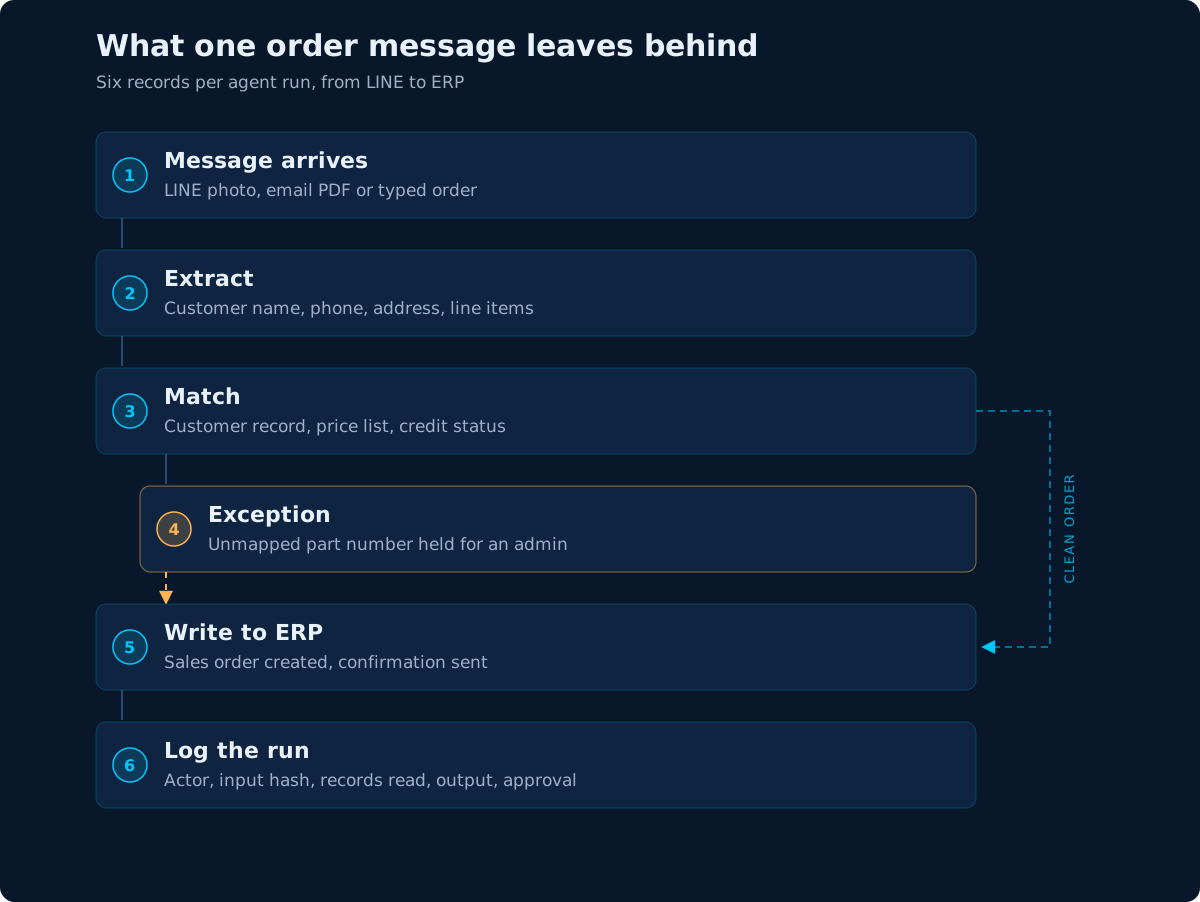 Steps 1 to 3 and 5 leave the trail. Step 4 is where a person appears, and where most disputes start.
Two choices follow. Set log retention longer than your worst realistic detection lag; logs deleted after seven days cannot scope a breach reported on day nine. And extend the record you already keep under Section 39 rather than starting a parallel AI register. The section asks for the data collected, the purpose of each category, the retention period, access rights and a description of security measures (PDPA, 2019). An agent is a processing activity. It belongs in the same document.
Who is the controller when your vendor trains on your data
A factory that buys an AI service usually becomes the controller, because it decides what customer data goes in and what happens to the output. The vendor is a processor while it acts on your instructions. If it uses your conversations to train its own models, it becomes an additional controller for that activity (Tilleke & Gibbins, 14 October 2026).
A contract that labels everything "processing on the customer's behalf" does not settle it. What the vendor does with the data does. Three questions before signing:
- Do you train on our prompts, outputs or documents, and can we turn that off in writing?
- Where are prompts and outputs stored, and can your staff or subcontractors read them?
- Can you confirm the scope of affected records within 72 hours of our notice?
A breach report needs a record count, and the count sits with the vendor. Put a named contact and a response time in the data processing agreement.
When an order agent needs a DPIA, and when it does not
The guidance recommends a DPIA before high-risk AI work: automated decisions with legal or significant effects, large-scale processing of sensitive data or children's data, and profiling or predictive analysis (Tilleke & Gibbins, 14 October 2026).
Reading line items off a purchase order does not meet that bar. The agent sees business data and a contact name. I would not open a DPIA for a first order-intake pilot, and I would not let a vendor sell one as a legal requirement.
The bar changes when the agent starts deciding. Credit limits are the obvious case: an agent that recommends holding an order over a payment history is making a decision with a significant effect. Employee screening, clinic records and driver scoring are the others.
If you cross that line, oversight has to mean the authority to change the result, not a click that approves what the model produced. The guidance recommends that, while noting the PDPA has no general right to human review of every automated decision (Formichella & Sritawat, 12 November 2026). Treat it as a control you can show, not a policy sentence.
Give the agent its own identity, and design for deletion
For agentic systems, the guidance recommends least-privilege access, identifiable agent accounts, activity logs and human approval for high-impact or irreversible actions (Formichella & Sritawat, 12 November 2026).
In an ERP that means a service account per agent, scoped to the objects it needs, with no shared admin login and no price or credit-limit changes without approval. When a run goes wrong you revoke one token, not a password half the office uses.
Deletion is harder. Section 37(3) requires a system for erasing personal data when the purpose ends or the person asks (PDPA, 2019). A vector store built as one undifferentiated pile makes that request a rebuild. Separate the index by customer, or at minimum carry a customer ID on every chunk so deletion is a filter rather than a project.
Machine unlearning is not settled, and the guidance does not certify any method as satisfying the law (Formichella & Sritawat, 12 November 2026). Delete from retrieval first, filter outputs in the interim, and write the limitation down. A documented gap beats a claim you cannot support.
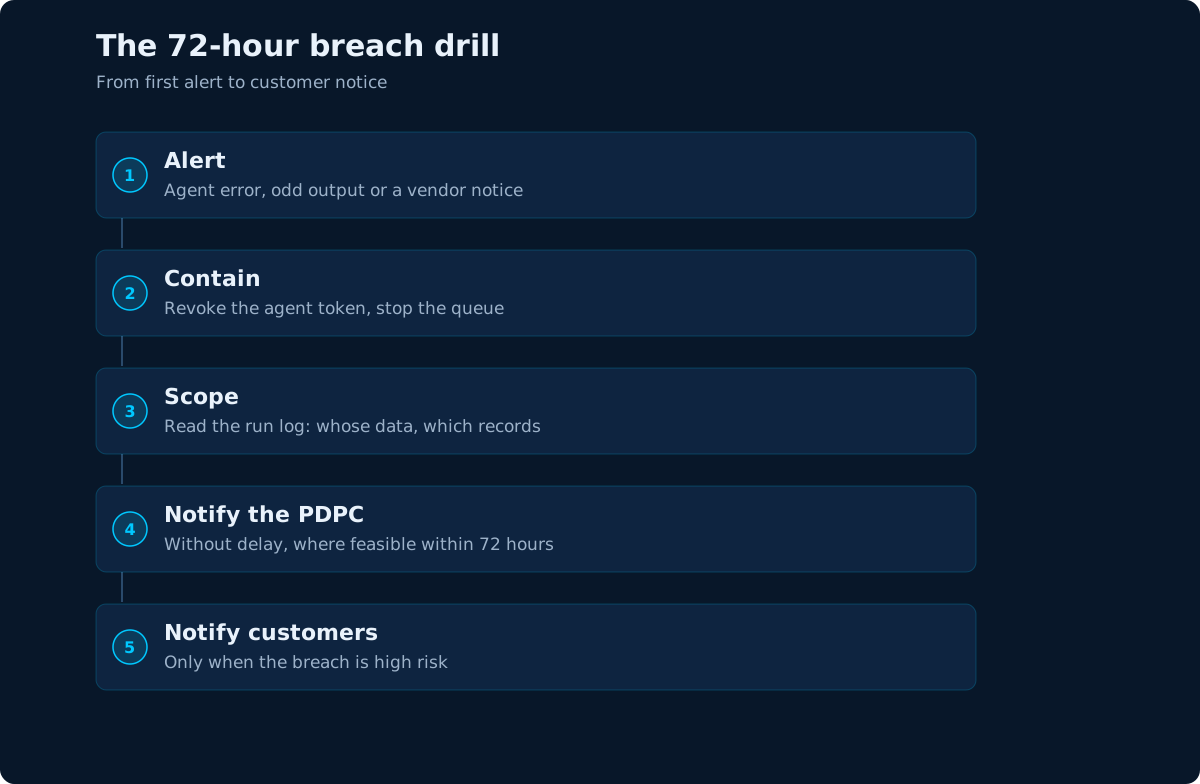 Step 3 is the one that fails when the agent kept no run log.
Conclusion
The guidelines do not add a new duty to your order desk. They make the old ones concrete: what counts as personal data when an agent reads a LINE message, and what you have to show after it goes wrong.
Start with the log, not the policy. Six fields per run, kept longer than your detection lag, and a line in the processing record that covers the agent. That is a week of work, and it decides whether you can file a breach report at all.
The order intake walkthrough shows where those records sit in a working flow. If you are building one, the automation service is where the audit trail gets designed in rather than bolted on, and the manufacturing page covers how we scope a first agent.
I hope this was helpful. If you want to test this on one of your own workflows, book a call for a free 30-min Workflow ROI Blueprint — bring the repetitive task that costs your team the most hours every week — or email me at clovis@n2olabs.ai.
Thank you,
Clovis
Sources
- Personal Data Protection Committee, Announcement on Guidelines for Personal Data Protection in the Development and Use of Artificial Intelligence Technology, B.E. 2569 (2026), Royal Gazette, 2 November 2026.
- Personal Data Protection Committee, Personal Data Protection Act, B.E. 2562 (2019), unofficial English translation, 2019.
- Tilleke & Gibbins, Thailand Issues Personal Data Protection Guidelines for AI Systems, 14 October 2026.
- Formichella & Sritawat, Thailand's PDPC AI Guidance: What Existing Law Requires and What the Regulator Recommends, Australian-Thai Chamber of Commerce, 12 November 2026.