
Clovis, 4 Nov 2026
Thailand's 45-day credit term rule: what factories must fix now
Thailand's 45-day credit term took effect on 2 November 2026, but the clock starts only when the document pack is complete. Here is the supplier and AP work that follows.
Thailand's 45-day credit term rule took effect on 2 November 2026. Large buyers must pay SME suppliers within 45 days, or 30 days for agricultural goods, counted from delivery plus a complete, correct document pack (Royal Thai Government, 6 October 2026).
That last clause decides your cash. If the pack is incomplete, the clock has not started, and a missing signature can push day zero into the next payment cycle.
Most reporting stopped at 45. The work is one clean pack on the day the truck leaves.
Key Takeaways
- Day zero is a document event: the term starts only when goods and a complete, correct pack have both been delivered.
- Large buyers with at least THB 500 million of revenue in Thailand are covered when they buy from an SME; a manufacturing SME is at most 200 employees and THB 500 million of annual revenue.
- A plant that delivers on the 3rd and invoices on the 12th has turned a 45-day term into 54 days.
- Fix the pack before buying software: PO reference, signed delivery note, tax invoice, and a due date calculated in code.
What changed on 2 November
The Trade Competition Commission notification was published on 2 October 2026 and took effect on 2 November 2026 (TCCT notification, 2 October 2026). Maximum terms:
- 45 days for general trade, manufacturing and services.
- 30 days for agricultural and primarily processed agricultural products with simple production.
- An existing shorter term still applies; the ceiling does not reopen a 30-day contract.
- A different term needs reasonable business, marketing or economic grounds, stated in the contract.
A large buyer cannot delay past the term without justification, change a term without justification or at least 60 days' notice, or impose the same unfair term on every SME through a standard contract (Tilleke & Gibbins, 6 October 2026).
But 45 is not an automatic offense. The government's briefing says the commission looks at scope, what was agreed, the reasons and the facts (Royal Thai Government, 6 October 2026). The rule changes what a buyer must justify, not just when it pays.
Does the rule cover your factory?
Two tests decide coverage. Both must pass.
The buyer needs at least THB 500 million of revenue from Thai operations in the previous financial year, with related companies in a single economic entity combined. You need to be an SME: manufacturing at no more than 200 employees and THB 500 million of annual revenue; service, wholesale or retail at no more than 100 employees and THB 300 million (Tilleke & Gibbins, 6 October 2026).
A 120-person auto-parts plant with THB 400 million of revenue qualifies. Its customer, a listed parts group or large retailer, almost certainly does too.
Above those ceilings, this notification gives you no 45-day protection. The lever is commercial, not regulatory.
The clock starts on documents, not on the delivery truck
The term starts when the SME has delivered the goods, or performed the service, in the agreed quantity, type, quality and standard, and has submitted complete and accurate documents (Royal Thai Government, 6 October 2026). Consignment starts when the goods actually sell, not when they reach the store.
You cannot make a buyer pay faster than the term. You can make day zero the delivery date, not the day accounts finds the invoice.
A plant delivers on the 3rd but invoices on the 12th because the accounts team waits for the month-end batch. Under a 45-day term the due date moves from the 18th to the 27th of the following month. Nine days of paperwork become nine days of cash, or thirty if the buyer pays in a monthly run.
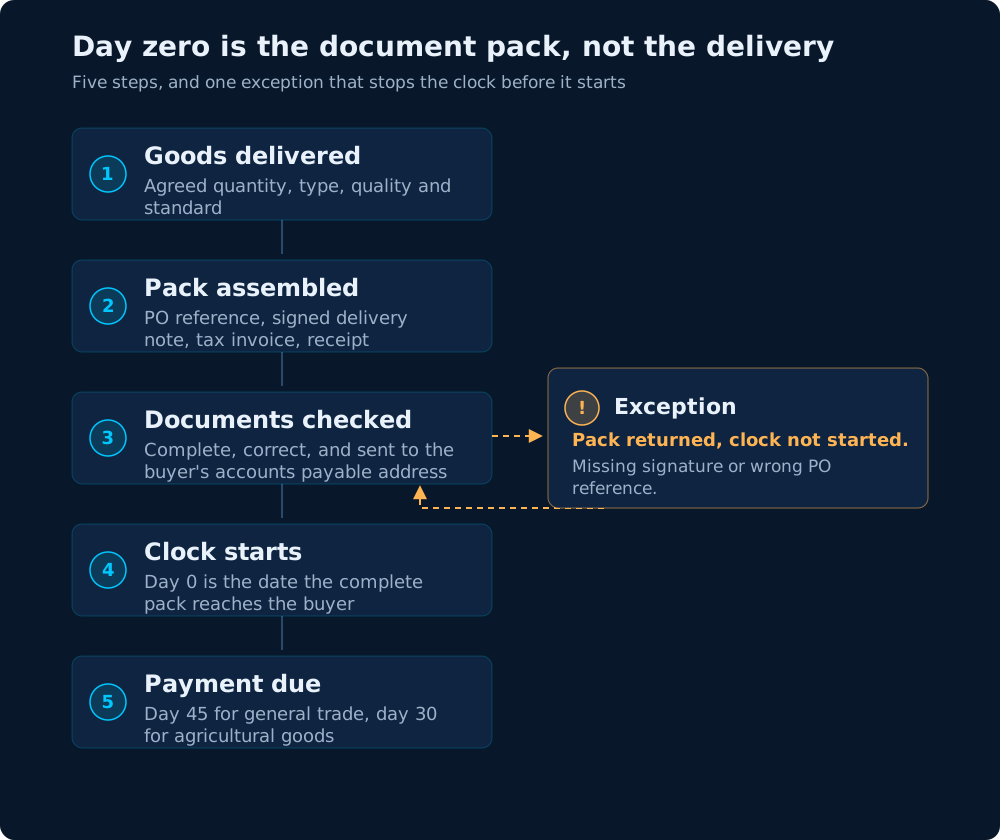 The clean path runs from a checked pack straight to day zero. An incomplete pack is returned and the clock never starts.
Two details cause most of the slippage. Thai documents often carry a Buddhist Era year, 2569 for 2026, and a reader that does not convert it will calculate a due date 543 years away. A tax invoice whose VAT line does not match the PO total goes into a query queue.
Public holidays are the third trap; a calculator that guesses the calendar will be wrong in the tightest months.
Supplier side: one pack, sent the same day
The target: accounts approve from the pack alone.
| Document | What it proves | What usually breaks |
|---|---|---|
| Purchase order or contract reference | The price, quantity and terms the buyer agreed to | A verbal order with no PO number, or a PO number quoted from an old email |
| Signed delivery note | What was delivered, when, and in what condition | The driver leaves before the receiver signs, or the date is left blank |
| Tax invoice | The amount due, the VAT, and the legal seller | Wrong legal entity, missing PO reference, a total that does not match the PO |
| Goods receipt or acceptance record | That the buyer's own warehouse booked the delivery | The receipt sits at the gate and never reaches accounts |
| Remittance details | Where the payment should go | A bank account change that was never confirmed in writing |
Same-day packing is a process problem. Someone owns the moment the truck leaves: scan the signed note, attach it to the invoice, check the PO reference, send it to the address the buyer monitors. That still beats a perfect invoice that arrives nine days late.
Chase on a schedule, not a feeling. Day 30, 40 and 44, with the pack date and calculated due date in every message. "Any update?" invites a status. "Documents complete 3 November, due 18 December, invoice 12345" gives the buyer something to match.
Keep a disputed line separate. If one item on a ten-line invoice is queried, ask for the clean lines to be scheduled and the disputed line re-invoiced. Keep the clean money moving.
Buyer side: 45 days is an accounts payable (AP) design problem
For the buyer, the duty is not "receive the invoice." It is to receive, match, approve and pay inside the term.
A three-way match compares PO, goods receipt and invoice. Every mismatch is an exception: a quantity that does not match the delivery note, a missing signature, a price that differs from the PO, a VAT total a baht off. The clean invoices are not the problem. The clean and exception queues run through the same two people.
Clear exceptions first and clean invoices wait. Clear clean invoices first and exceptions age past the term. Either way someone is late, and the supplier cannot tell which queue their invoice is in.
The notification also requires buyers to inform SME suppliers that they have a right to payment within the term, and to explain the payment procedure (Tilleke & Gibbins, 6 October 2026). A line in an onboarding pack is not enough if accounts cannot give a payment date.
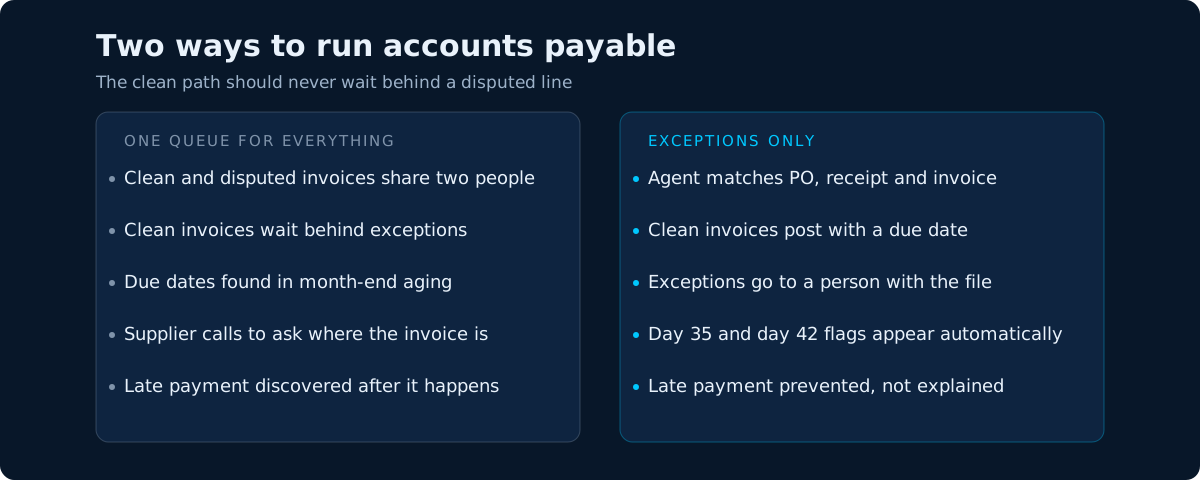 The clean path should never wait behind a disputed line. The exception queue is the only place a person is needed.
The Thai SME Council estimated the change could release at least THB 250 billion of working capital, and up to THB 750 billion if 90-day cycles fall to 45 (The Nation, 24 October 2026). It is an industry estimate, not a government forecast, and it assumes compliance.
What to automate, and what must stay human
Document handling suits an agent. Payment decisions do not.
We build these workflows in three layers, because each fails differently.
Layer 1: read. The agent reads POs, delivery notes and invoices from LINE, email or scanned PDFs and pulls out customer, PO number, line items, quantities, units, dates and totals. Target at least 95% extraction accuracy on your own documents, measured before go-live, not a vendor benchmark. This is the same matching that automated order intake depends on.
Layer 2: approve. Anything uncertain goes to a person with the source document beside the extracted fields. A quantity mismatch, a missing signature, a part number that maps to two SKUs: approval decisions, not extraction errors. Nothing is sent or posted until a person clears it.
Layer 3: calculate. Due dates, VAT and aging come from deterministic code, not the model. The code converts Buddhist Era dates, applies contract terms and flags invoices nearing day 45. If it is wrong, you can read the function. You cannot audit a generated sentence.
That split matters because the rule is about evidence: the agent produces the pack and the date, the person decides exceptions, the code does the arithmetic.
What it costs
We price a workflow as fixed scope, anchored to a fraction of one admin salary for the process being replaced. You own the workflow, prompts and code at handover, with optional monthly monitoring. We do not quote before seeing the documents, because the exception rate decides the build.
Three numbers to watch
Measure the process, not the software.
- Days from delivery to complete pack. Median, not average. Over one working day, your 45 days are already shorter than you think.
- Share of invoices paid inside the term. By due date, not by month. Due on the 18th and paid on the 25th is late even in the same month.
- Days sales outstanding (DSO). From the accounts receivable ledger, on the same segment before and after. Falling DSO with a rising exception rate usually means late invoices are paid first and the queue is hidden.
The leading indicator is the exception rate per hundred invoices: how much of the week goes to documents that will never match without a conversation.
Conclusion
The 45-day rule is a document deadline in disguise. The buyers in scope are the large ones you already know, and a 100-to-200-person plant under the THB 500 million revenue ceiling qualifies (Tilleke & Gibbins, 6 October 2026). What decides whether it helps you is whether day zero is the delivery date or the day the pack becomes complete.
Start with one customer and one channel. For two weeks, log the date the truck left, the date the pack was complete and the date the buyer booked the invoice. If the gap is two days, fix the process. If it is ten, the process is the product.
I hope this was helpful. If you want to test this on one of your own workflows, book a call for a free 30-min Workflow ROI Blueprint — bring the repetitive task that costs your team the most hours every week — or email me at clovis@n2olabs.ai.
Thank you,
Clovis
Sources
- Royal Thai Government, "รัฐบาลแจ้งกติกาใหม่ Credit Term เริ่ม 2 พ.ย. นี้ รายใหญ่จ่าย SME ภายใน 30 วันสินค้าเกษตร–45 วันการค้าและบริการ" (in Thai), 6 October 2026 — effective date, term limits, day-zero rule, consignment and the 60-day notice.
- Trade Competition Commission of Thailand, notification on fair trade practices concerning credit terms between large businesses and SMEs, Royal Gazette, 2 October 2026 (in Thai).
- Tilleke & Gibbins, "Thailand Issues New Credit-Term Rules for Large Purchasers from SMEs", 6 October 2026 — revenue threshold, SME definitions and buyer duties.
- The Nation, "Thailand Enforces Stricter Credit Terms to Release THB250bn Working Capital for SMEs", 24 October 2026 — Thai SME Council liquidity estimates.