Clovis, 16 Nov 2026
AI workflow redesign: why AI pilots add work in Thai factories
AI spending is rising in Thailand, but bolting a model onto an old order flow often adds a checking step. Here is how to redesign one order-to-invoice flow so people only handle exceptions.
Bolting AI onto an order desk that still runs on retyping does not remove work. It adds a step: the admin asks a model to read the LINE photo, checks the answer, then types it into the ERP anyway.
An AI workflow redesign starts from the other end. Map the order-to-invoice flow, remove the copies that exist only because two systems cannot talk, and give the person one job: the exceptions. The model reads documents. Your master data decides what is true. The ERP records it.
That matters in Thailand this year, because spending is rising whether or not the flow changes.
Key Takeaways
- Adding AI to an unchanged order flow adds a checking step, which is why a pilot can look busy and still leave margin, cost and speed flat.
- The fix is a redesign of one flow, order to invoice: a single intake queue, extraction to a fixed schema, matching against master data, and a person only on exceptions.
- Measure touch count per order, order-to-sales-order time, exceptions per 100 orders, and errors found after posting. A demo's "time saved" usually leaves out the minutes spent reviewing the output.
- Some order desks should not get AI yet: when part numbers are unstable, when nobody owns the flow, or when one admin can still handle the volume with a shared inbox.
What "AI theatre" looks like at the order desk
At Nation Forum 2027 in Bangkok, Ruangroj Poonpol of the H.O.W. Club described companies that keep funding AI pilots while margins, cost and speed stay flat. He called it "AI theatre," and cited figures showing AI investment rising from 0.8% to 1.7% of revenue in 2026 (The Nation, 20 October 2026).
Adding an AI-powered step and then another checking stage can increase the workload instead of reducing it, he said.
Anyone who has watched an order desk knows the pattern. The admin opens a LINE photo, pastes the text into a chat window, gets a clean list back, re-reads it against the customer's part numbers, checks the price in the ERP, and keys the order by hand. The model saved the typing of one field. The check, the lookup and the entry stayed. Two steps now where there was one, plus a browser tab.
Ruangroj put the split at 10% technology, 20% technology and data infrastructure, and 70% people and change management (The Nation, 20 October 2026). Treat that as his framework, not a law. The tool is cheap; the workflow is expensive.
Why the checking step keeps coming back
The check is not stubbornness. It exists because the model has no authority over the facts that decide the order: the customer's part number, the agreed price, the credit limit, the stock on hand. A language model can produce a plausible part number. It cannot commit a price.
So the person checks, and the checking becomes the new bottleneck. monday.com's 2026 AI report found that 53% of leaders say AI has made it harder to evaluate original contributions, and 47% say they spend more time reviewing and guiding team output (monday.com, The AI Report 2026, 21 October 2026). The survey covered 1,700 directors and senior managers in seven countries and was run by Nielsen for monday.com (TechCrunch, 21 October 2026).
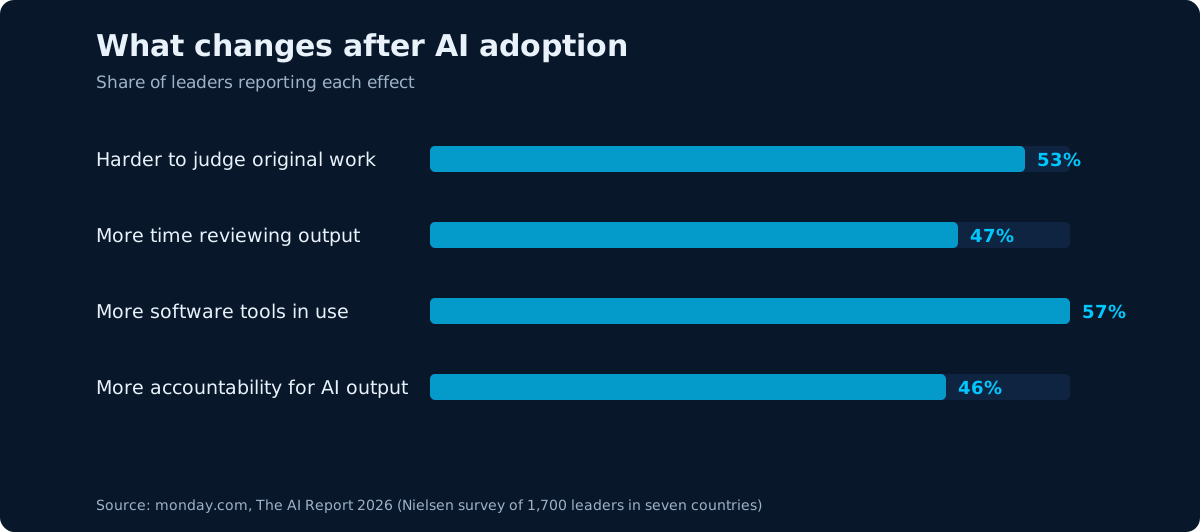 The review load rises even when individual tasks get faster.
The report calls this "invisible labor": someone decides what to hand the agent, checks what comes back, and steps in when it is wrong. In an order desk, that person is the most experienced admin, the one who knows every customer's part-number quirks. The automation lands on the person with the least spare time.
Headcount does not fall after the pilot. The typing moved. The judgment did not, and judgment is slower.
Count the handoffs before you count the prompts
Before choosing a tool, draw the flow on a whiteboard. One order, from the customer's message to the invoice.
A typical sequence at a Thai manufacturer:
- The order arrives on LINE, by email, or as a printed purchase order.
- A sales admin writes the lines into a spreadsheet or a paper form.
- Someone checks price and stock in the ERP.
- The order is keyed into the ERP as a sales order.
- Picking or production receives a copy.
- Finance invoices from a second copy.
Six steps, and the same part number is typed at least three times. Each retype can introduce an error, and each handoff is a place an order waits.
Now mark every step where a person copies data between systems. That list, not the list of AI use cases, is your roadmap. Most of those steps exist because two systems cannot talk, and most need no model at all.
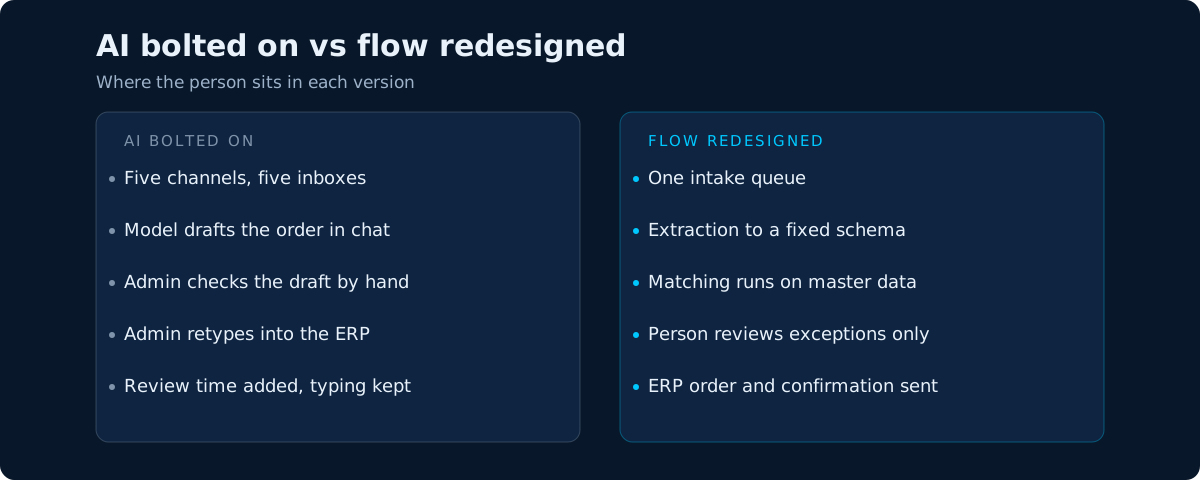 The difference is where the person sits, not how clever the model is.
If you want the measurement discipline first, the AI ROI guide for Thai companies covers how to baseline a process before buying anything.
Redesign one order-to-invoice flow in five steps
Pick one flow. Not the whole plant, not every channel. One customer segment and one order path you can watch end to end.
- One intake queue. LINE photo, email attachment, PDF, typed message all land in the same table. Not five inboxes with five owners. The queue is a database, not a person's chat history.
- Extract to a fixed schema. Customer, PO number, line items, quantity, unit, requested date. Same field names every time, because the next step depends on them. Keep the original document beside the extracted data.
- Match against master data. Map the customer's part number to your SKU, convert the unit, pull price and stock. This decides whether the system is useful. Extraction is a commodity now; the mapping table is the work.
- Hold exceptions for a person. A missing part-number mapping, a price that differs from the list, a new customer, a credit hold. The admin sees the source document next to the disputed line and clears it without opening another screen.
- Write to the ERP and confirm on the same channel. The sales order is created, and the reply goes back where the order came from. A LINE customer gets a LINE message, not an email they will not read.
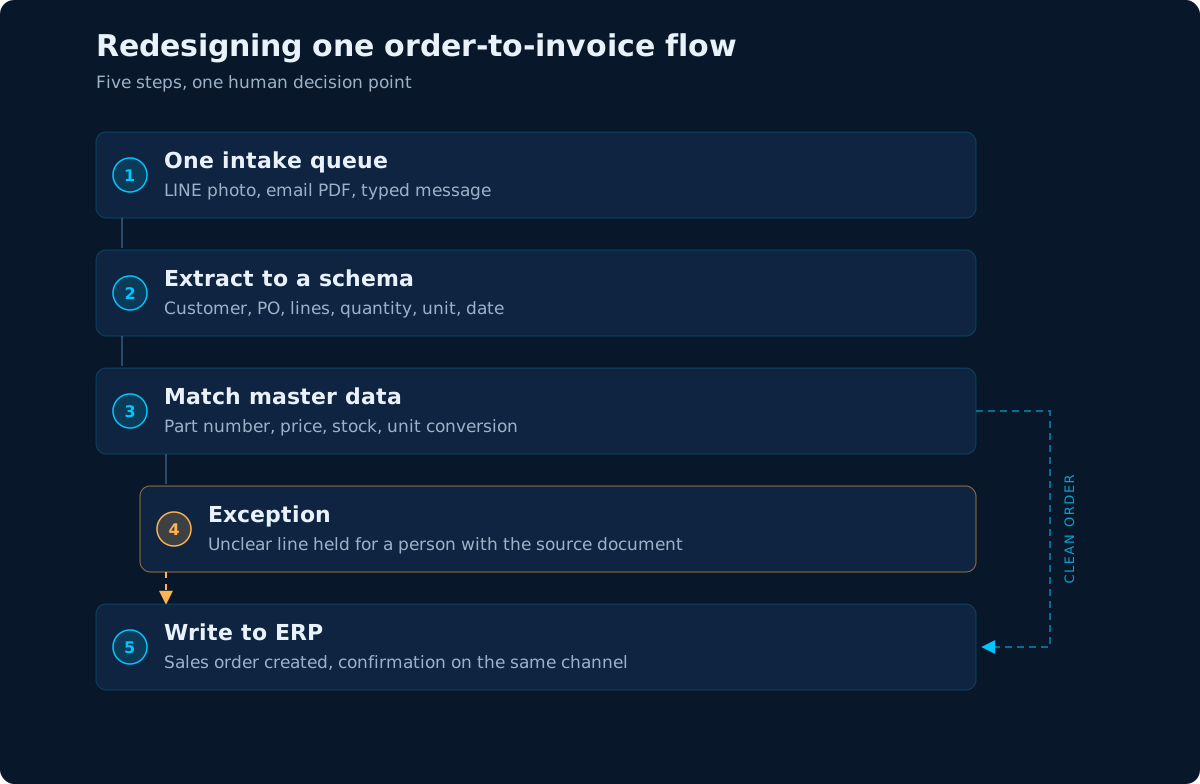 Steps 1 to 3 and 5 should run without a person. Only the exception branch in step 4 needs one.
The exception path is the product. A system that posts every order without a person is not ambitious; it is unsafe, because nothing can stop a wrong price or an unknown part number. A system that routes a minority of lines to a person, document attached, is working. A normal exception should clear in under a minute.
The ERP constraint bites here. Most of the effort is not the model. It is the customer part-number map, the unit conversions, and the rule for which price wins when the customer's PO disagrees with your list. Those are business decisions, and no vendor makes them for you. The automation service and the order intake walkthrough go deeper on the plumbing.
What to measure instead of "time saved"
Vendor demos measure extraction because it is easy to show. They rarely count the minutes the admin spends checking the result, or the rework when a wrong order reaches dispatch.
Measure four things on the same order mix for two weeks before the change and four weeks after.
| Metric | How to count it | Direction |
|---|---|---|
| Touch count per order | Times a person types or copies the same data | Down |
| Order-to-sales-order time | Customer message timestamp to ERP sales order timestamp | Down |
| Exceptions per 100 orders | Lines held for a person, divided by lines received | Down, then stable |
| Errors found after posting | Credit notes, re-picks and re-invoices caused by a wrong order | Down |
The business case is review minutes plus rework minutes, against the minutes the old flow took. Suppose a pilot cuts extraction from four minutes to one and adds three minutes of checking. It has saved nothing.
Measure the exception rate before you automate, too. If a large share of lines is ambiguous, the problem is master data, and a better model will produce better-looking mistakes.
When the answer is no AI
I would not start with an agent in three situations.
The part-number map lives in one person's head. Automate on top of that and you copy the confusion into a system that runs faster. Fix the map first. It is unglamorous, and it is the project.
Nobody owns the flow. If sales, warehouse and finance each describe a different order path, there is no process to automate. Name one owner with authority to change the steps.
The rule is deterministic. If the job is "attachment arrives, rename it, file it, post it," a workflow tool does it without a language model, cheaper and more predictably. The comparison of AI agents and RPA covers where the line sits.
One wider caution. Apollo Global Management's chief economist, Torsten Slok, looked at the S&P 493, the S&P 500 minus the big technology names, and found flat margins and revenue per worker, concluding AI had delivered "zero financial payoff" outside tech (TechCrunch, 25 October 2026). That is a US large-cap sample, not a Thai plant. But it points at the same mechanism: spending without changing the process.
Conclusion
Start with one flow and one week of counting. Draw the order-to-invoice path, mark every retype, put a number on the review minutes. If the flow has six handoffs, you do not have an AI problem. You have a handoff problem that AI will make more expensive.
Then redesign that one flow and leave the person in the exception branch, with the source document in front of them. That is the version of AI workflow redesign that shows up in margin instead of a slide. To see where a build like this fits, start with the manufacturing page.
I hope this was helpful. If you want to test this on one of your own workflows, book a call for a free 30-min Workflow ROI Blueprint — bring the repetitive task that costs your team the most hours every week — or email me at clovis@n2olabs.ai.
Thank you,
Clovis
Sources
- The Nation, "Ruangroj warns of 'AI theatre' citing AI investment at 1.7% of revenue in 2026", 20 October 2026 — the 0.8% to 1.7% figure, the added checking step, and the 10/20/70 framework.
- monday.com, "The AI report 2026: leader confidence meets the rise of agents", 21 October 2026 — 53% harder to evaluate original contributions, 47% more time reviewing output, 57% more tools, 46% greater accountability.
- TechCrunch, "AI promises productivity, but for managers, it's mostly a headache for now", 21 October 2026 — Nielsen survey of 1,700 directors and senior managers across seven countries, commissioned by monday.com.
- TechCrunch, "AI delivers 'zero financial payoff' to most companies, Apollo economist says", 25 October 2026 — Torsten Slok's S&P 493 finding and quote.